 crackthe.net

Beyond the VPN: private email with Proton Mail and Hushmail
A VPN protects your connection, not your mailbox. What end-to-end and zero-access encryption mean, and what Proton Mail and Hushmail state about them.
Key points
- A VPN hides your IP address and your browsing from your internet provider. It does not protect what is stored in your mailbox.
- A regular email provider can read every message that is not end-to-end encrypted, and so can anyone who gets access to its servers.
- For more privacy, use a privacy-first email provider alongside your VPN. Two examples: Proton Mail and Hushmail.
What a VPN does not cover
A VPN encrypts the path from your device to the VPN server. Your emails, though, are stored on the servers of your email provider, often for years. The VPN changes nothing about who can read them there.
- Youwrite an email
- Your email providercan read it, unless it is end-to-end encrypted
- The recipient's providercan read it too
- Recipient
Three kinds of email encryption
| Kind | What it protects | Who can still read the message |
|---|---|---|
| Transport encryption (TLS) | the trip between servers | each email provider on the way |
| Zero-access encryption | stored mail on the provider’s servers | you; the provider says it cannot |
| End-to-end encryption | the message from sender to recipient | only sender and recipient |
Most large email services use transport encryption. Privacy-focused providers add zero-access and end-to-end encryption.
VPN and private email: what each one does
| VPN | Private email | |
|---|---|---|
| Hides your IP address from websites | yes | no |
| Hides your browsing from your internet provider | yes | no |
| Protects stored messages | no | yes, with zero-access encryption |
| Protects message content to the recipient | no | yes, with end-to-end encryption |
Used together, the two cover your connection and your mailbox.
Two providers that put privacy first
The following comes from the providers’ own websites. This archive does not measure or test email services.
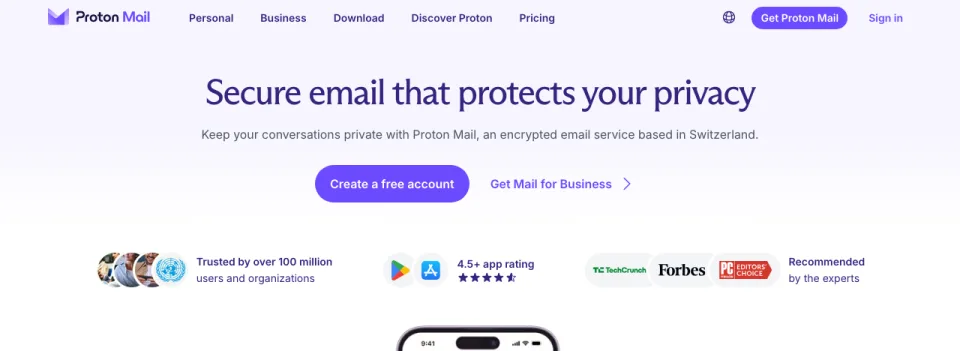
- End-to-end and zero-access encryption: “Zero-access encryption means we never see your inbox, on any plan.”
- A free plan: “Proton Mail will always offer a free secure email plan.”
- Run by Proton AG, which says it is incorporated and headquartered in Switzerland; the same company runs Proton VPN.
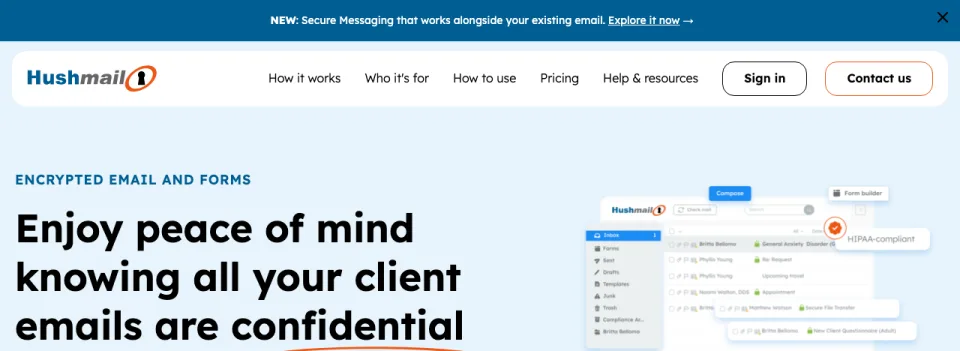
- Encryption per email: “To encrypt an email, just click the toggle.”
- Encrypted email and e-signable forms, mainly for healthcare, legal, and small-business use; also offered for personal use.
- No free plan listed; its website offers a 14-day free trial of the healthcare plan. Servers in Vancouver and Calgary, Canada, according to its privacy policy.
From the providers' own websites. Email services are not measured or tested in this archive.
Proton Mail comes from Proton AG, the company behind Proton VPN, which this archive does track. The Proton VPN page shows what our data says about its server list, its website, and its audits as Proton describes them.
Hushmail focuses on professionals who handle sensitive client data, such as therapists and lawyers. It adds forms that clients can sign online. It also offers plans for personal use.
How to switch without losing mail
- Create the new account and turn on two-factor authentication.
- Forward your old address to the new one for a few months, so nothing gets lost.
- Update your important accounts (bank, government services, shopping) to the new address, one by one.
- Tell your contacts. End-to-end encryption works best when both sides use it. Check how each provider handles messages to people outside its service.
Encryption is not anonymity. The provider still knows your account, your payment details if you pay, and when you log in. A VPN can hide your IP address from it. Your logins still identify you.
Next step
If you have not chosen a VPN yet, the VPN finder shows which providers meet your criteria. All guides are listed on the guides overview.
The figures in this guide come from the archive and change with every data update. As of November 1, 2026.