 crackthe.net

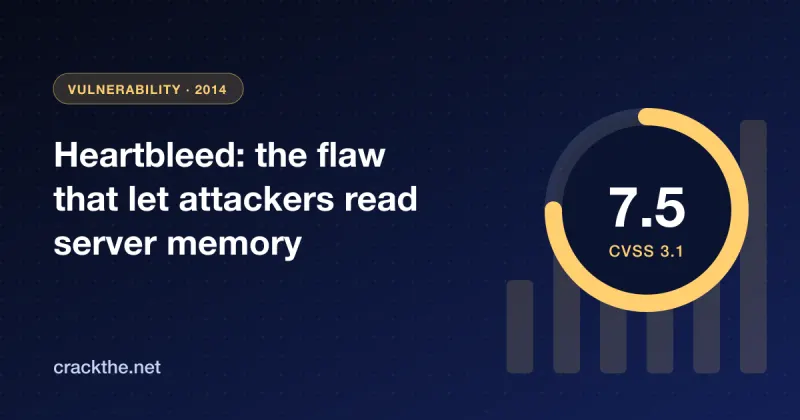
Heartbleed: the flaw that let attackers read server memory
In April 2014, an OpenSSL flaw let attackers read the memory of 24–55 % of popular HTTPS servers. How it worked and why patching alone was not enough.
What to do now
- Update OpenSSL versions 1.0.1 to 1.0.1f to 1.0.1g or newer.
- If you cannot update at once, rebuild OpenSSL with the option
-DOPENSSL_NO_HEARTBEATS. - Treat keys made with a vulnerable version as stolen: create a new private key, get a new certificate and revoke the old one.
- Check appliances and embedded devices too: many shipped with a vulnerable OpenSSL version.
- Year
- 2014
- CVSS 3.1 score
- 7.5 high
- of HTTPS servers among the top million websites were vulnerable at first
- 24–55 %
- of the top million HTTPS sites replaced their certificates within three weeks
- 23 %
- Reach met
24–55 % of HTTPS servers in the Alexa Top 1 Million were vulnerable at first, and about 2 million HTTPS servers two days after disclosure (The Matter of Heartbleed, 2014).
- Mass exploitation not met
Researchers counted 5,948 attack attempts against 217 targets at four monitored networks; the sources document no mass attacks (The Matter of Heartbleed, 2014).
- Damage not met
No reliable total exists; the theft of 900 social insurance numbers from the Canada Revenue Agency is known only from the press (CTV News).
- Extraordinary response met
Keys and certificates had to be treated as compromised (US-CERT), and 23 % of HTTPS sites in the Alexa Top 1 Million replaced their certificates within three weeks (The Matter of Heartbleed, 2014).
| Affected | OpenSSL, the encryption software behind many HTTPS servers |
|---|---|
| CVE | CVE-2014-0160 |
| CVSS vector | CVSS:3.1/AV:N/AC:L/PR:N/UI:N/S:U/C:H/I:N/A:N |
| Weakness (CWE) | CWE-125 |
| Fixed in | OpenSSL 1.0.1g (April 7, 2014) |
| On CISA's list of exploited vulnerabilities since | May 4, 2022 |
| Found by | Google's security team and Codenomicon, independently of each other |
- 1Flaw added to the code
- 2Discovered+811 days
- 3Reported to the vendor+822 days
- 4Fix available+828 days
- 5First attacks seen+829 days
- 6Added to CISA's list of exploited vulnerabilities+3777 days
On April 7, 2014, the OpenSSL project fixed a flaw that let anyone on the internet read pieces of a server’s memory, including passwords and sometimes the server’s secret keys. OpenSSL is a software building block that many web servers, mail servers and devices use to encrypt their connections, for example for HTTPS, the secure form of the web. A measurement study estimates that 24–55 % of the HTTPS servers of the million most visited websites were vulnerable at first.
How it worked
Encrypted connections on the web use a protocol called TLS. It has a “heartbeat” feature that keeps a connection open: one side sends a small message together with a number that says how long the message is, and the other side sends the message back.
OpenSSL trusted that number and never compared it with the real length. An attacker could send a message of one byte but claim that it was 65,535 bytes long. The server then copied up to 64 KB of whatever lay next to the message in its memory into the reply. That could include session cookies, which keep users logged in, passwords, and sometimes the server’s private key, the secret that protects its encrypted connections.
The request left no trace in normal logs and could be repeated again and again, each time for a new piece of memory. The same bug also worked the other way round, against programs that connected to a malicious server. The faulty code was added to OpenSSL on December 31, 2011, and released in version 1.0.1 on March 14, 2012, so it was in use for about two years before it was found.
- Attackersends a heartbeat with 1 byte of data
- OpenSSLbelieves the claimed length of 65,535 bytes
- Server memoryup to 64 KB is copied into the reply
- Attackerreads passwords, cookies or even keys
Reach and damage
The best measurements come from “The Matter of Heartbleed”, a 2014 study by researchers at the University of Michigan, the University of California Berkeley, the research institute ICSI and Purdue University. It uses the Alexa Top 1 Million, a ranking of the million most visited websites. The authors estimate that 24–55 % of the HTTPS servers on that list were vulnerable when the flaw became public, including at least 44 of the top 100 sites. One of the finders had first spoken of 66 %, based on the market share of the web servers Apache and nginx; the study calls this too high.
Large sites patched fast: within 24 hours, all but 5 of the top 100 had installed the fix. Two days after disclosure, 11.5 % of the HTTPS sites in the Alexa Top 1 Million were still vulnerable, as were 6 % of all HTTPS servers on the internet, about 2 million machines. After about two weeks, the decline almost stopped.
| At first, low estimate | 24 % | |
|---|---|---|
| At first, high estimate | 55 % | |
| April 9, 2014 | 11.5 % | |
| June 4, 2014 | 3.1 % |
The first two bars are the range the study estimates for the start, the other two are measurements. Source: The Matter of Heartbleed (2014).
Websites were not the only systems at risk. In a sample of 1 % of the internet, 7.5 % of the mail servers with encryption were vulnerable. Three days after disclosure, 48 % of the relays of Tor, a network for anonymous browsing, were still vulnerable. A full scan of the internet on April 24, 2014, found 588,686 vulnerable machines; 56 % of them were embedded devices, small devices with built-in software.
The researchers also searched recorded traffic from four monitored networks for attacks. They found no attempt before the flaw was made public. The first came 21 hours and 29 minutes after disclosure, and in total they counted 5,948 attempts from 692 sources against 217 targets. How much data was stolen worldwide is unknown. The best-known case comes from the press: the Canada Revenue Agency, Canada’s tax authority, said that 900 social insurance numbers were taken through Heartbleed. No reliable total of the damage exists.
The fix and the response
Google’s security team found the flaw on March 21, 2014, and patched its own servers the same day; it told the OpenSSL team on April 1. The Finnish security firm Codenomicon found the flaw independently in early April and reported it through NCSC-FI, Finland’s national cyber security center. On April 7, OpenSSL released version 1.0.1g. The fix is simple: OpenSSL now drops heartbeat messages that claim to be longer than the data they contain.
Updating alone was not enough, because an attacker could have copied a server’s private key without leaving a trace. The US-CERT, the US government’s computer emergency team, warned: “Any keys generated with a vulnerable version of OpenSSL should be considered compromised.” Operators had to create new keys, get new certificates, the digital ID cards of websites, and revoke the old ones, so that browsers would stop trusting them. Between April 9 and April 30, 23 % of all HTTPS sites in the Alexa Top 1 Million replaced their certificates and 4 % revoked them.
Sites that were slow to patch were also slow to replace their keys:
| Had installed the fix | 73 % | |
|---|---|---|
| Had replaced their certificate | 10.1 % |
Sites in the Alexa Top 1 Million that were vulnerable on April 9, 2014. Source: The Matter of Heartbleed (2014).
Of the vulnerable sites that did replace their certificate, 14 % reused the same private key, which gave no protection, and only 19 % revoked the old certificate. Warnings helped: in an experiment with about 150,000 vulnerable machines, operators whom the researchers notified patched 47 % more than those who were not notified.
The National Vulnerability Database rates Heartbleed 7.5 out of 10 on CVSS 3.1, “high” rather than “critical”, because the flaw lets attackers read data but not change it or shut down a server.
Sources
- OpenSSL security advisory of April 7, 2014 openssl-library.org
- Codenomicon: heartbleed.com, the finders' page about the bug heartbleed.com
- The Matter of Heartbleed, ACM Internet Measurement Conference (2014, PDF) nebelwelt.net
- NVD: CVE-2014-0160 nvd.nist.gov
- US-CERT alert TA14-098A cisa.gov
- CTV News (press): CRA says 900 social insurance numbers were taken ctvnews.ca
Read next: ConfickerPrevious: ShellshockOverview: Vulnerabilities